Phosphate and Banaba
One island, one resource, one of the Pacific's most complete acts of colonial dispossession — and the money that held an administration together for decades.
01The Rock in the Middle of the Ocean
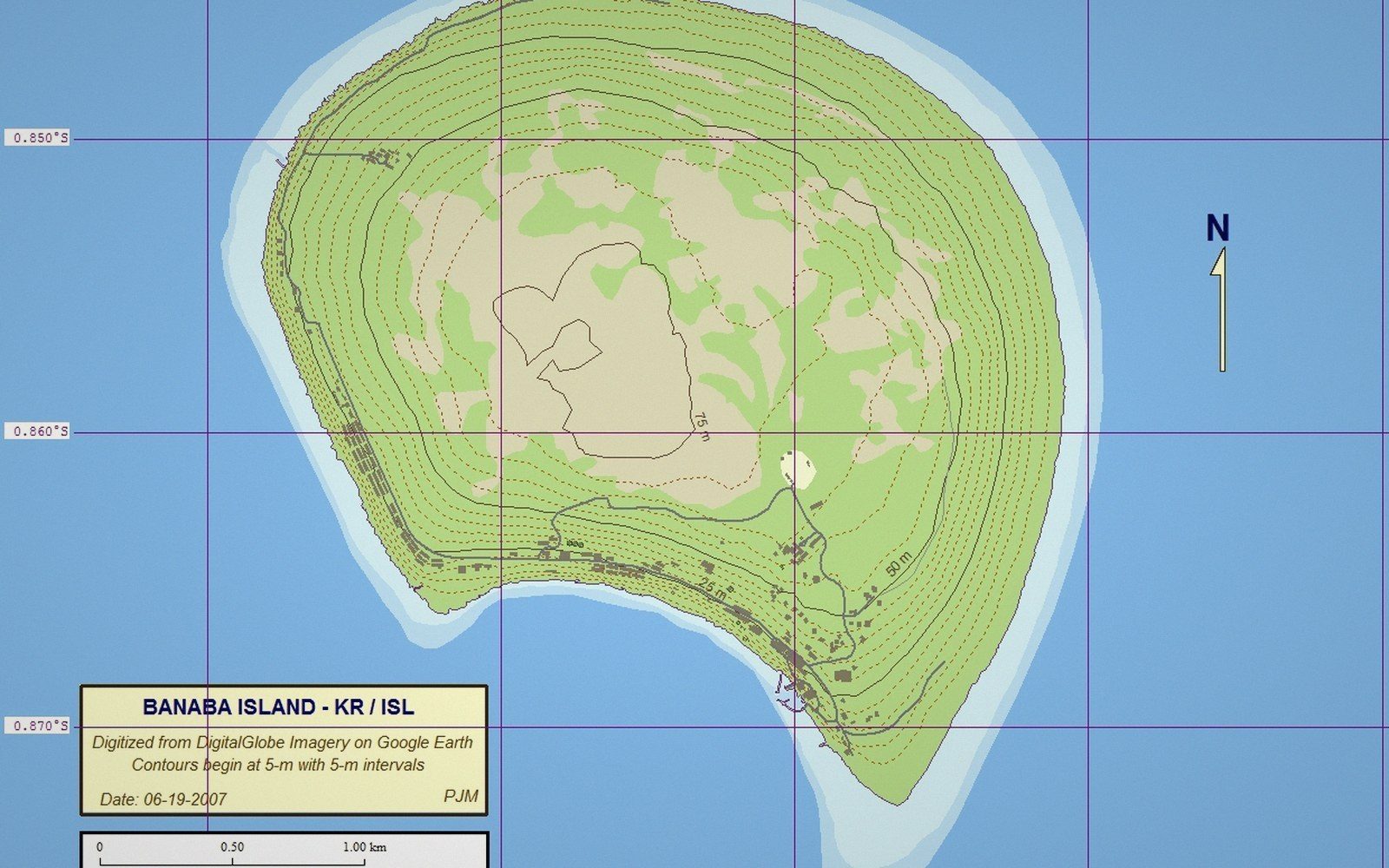
Banaba — called Ocean Island under British administration — sits alone in the central Pacific, roughly 400 kilometres west of the Gilbert group and closer to Nauru than to any other Gilbertese land. It is not an atoll. It is a raised coral island, a chunk of ancient reef limestone pushed up by tectonic pressure to a height of about 81 metres — which makes it, by a considerable margin, the highest ground in what is now Kiribati. That elevation turned out to matter enormously, not because it offered safety from the sea but because of what had accumulated inside the rock over geological time.
In 1900, prospectors working for the Pacific Islands Company identified the island's plateau as one of the richest phosphate deposits in the world. Phosphate rock, ground and treated, becomes superphosphate fertiliser. The soils of Australia and New Zealand were hungry for it, and the British Empire had found the supply. A mining concession was secured, the British Phosphate Commission was eventually formed with British, Australian and New Zealand government interests, and Banaba's fate was set. Its people — the Banabans, who had lived on the island for centuries and numbered only a few hundred — had no meaningful say in any of it.
02Extraction and Its Consequences
Mining began in earnest in the early twentieth century and accelerated steadily. The Banabans received payments that bore no relation to the scale of extraction. Land was compulsorily acquired, well-heads sunk, and the island's plateau progressively carved away. The administration that governed the Gilbert and Ellice Islands Colony used phosphate revenues as a central pillar of its budget: the royalties and profits underwrote the running costs of a territory spread across millions of square kilometres of ocean, most of which generated almost no revenue at all. What the Banabans lost in land and autonomy subsidised governance elsewhere.
The Japanese occupation during the Second World War interrupted mining and brought atrocity to the island. In 1942 and again in 1945, Japanese forces killed Banaban civilians and a small number of British residents; a massacre in the final weeks of the war eliminated much of the remaining population that had not already been evacuated. By the time the war ended, the Banaban community was shattered.
The British response to this catastrophe was to decide that the Banabans should not return home. Resettlement was arranged on Rabi Island in Fiji — purchased using Banaban community funds held in trust, without the community's fully informed consent — and in 1945 the surviving Banabans were taken there. Some accepted this as a new beginning. Many understood it as a second dispossession.
03The Mining Continued Without Them
The Banabans' absence did not slow extraction. Mining resumed and continued for three more decades, the British Phosphate Commission shipping rock to Australia and New Zealand, and the revenue flowing through colonial accounts. The Banabans on Rabi, a full ocean away, received periodic royalty payments that remained modest relative to the value of what was being taken. Meanwhile the island that had been their home was being systematically destroyed: the plateau — the highest, most habitable ground — was being quarried out of existence.
By the time phosphate extraction finally ended, in 1979, the island's surface had been so thoroughly worked that significant parts of it were simply gone. The physical transformation was irreversible. The resource had been exhausted, the landscape permanently altered, and the people who had owned it were on another island in another country.
Legal action followed. In the early 1970s, Rabi Island councillors brought a case in the English courts against the British Phosphate Commission, the British government, and others, seeking compensation for wrongful dispossession. The litigation was protracted and technically difficult; the judge found against the Banabans on most counts, though some compensation was eventually negotiated. The sums involved were not proportionate to what had been taken. No formal apology was issued.
04What This Meant for Kiribati
Kiribati became independent in 1979, the same year mining ended. The new nation inherited an island that had been emptied of its people and stripped of its defining resource. Banaba is part of Kiribati in constitutional terms; the Banabans hold Kiribati citizenship and their community retains a right of return that very few have exercised, partly because the island's infrastructure is minimal and its ecology permanently altered, and partly because Rabi has, across two generations, become genuinely home.
The phosphate revenue itself left a mixed legacy. It had funded colonial administration, not development of the Gilbertese islands in any systematic way. It built roads and offices and paid officials, but it did not leave the islands with industries, institutions or infrastructure that could sustain an independent state. When phosphate ended and independence came simultaneously, Kiribati had to find a different economic model — which it has done primarily through fishing licence revenue from its enormous exclusive economic zone. The contrast is instructive: the phosphate economy extracted a finite resource and left the land destroyed; the licence economy, in principle at least, can be managed without physical depletion.
The Banaban story also complicates the standard narrative of decolonisation. The Gilbert and Ellice Islands Colony is sometimes described as a relatively benign administration; Banaba is the evidence against easy generalisations. A small community lost its land, its home island and control of its own assets within the space of a few decades, all under the legal authority of a colonial government that was simultaneously profiting from the arrangement. The mechanisms — compulsory acquisition, forced resettlement, trust funds managed by the colonial power — were entirely lawful by the standards of the time. That lawfulness is part of what makes the record worth examining plainly.
05Banaba Today
The island now holds a small caretaker population and the ruins of the mining infrastructure: concrete structures, rusted machinery, the physical residue of industrial extraction on a tiny landmass. Some Banabans make periodic visits, and there are recurring discussions within the community about the terms of any eventual return. The Banaban community on Rabi maintains its distinct identity, its council structure, and its claims on the island's history.
Banaba's phosphate is gone. The plateau that contained it is gone. The community that called the island home was moved by colonial decision and funded, in part, by the proceeds of the resource being mined from under them. None of that is disputed; it is simply a matter of record. What remains is an island of ruined machinery and deep legal and emotional claims, and a diaspora community on a Fijian island that has been making its own history for longer now than the mining ever lasted.
--- An independent guide to Kiribati. Not a tour operator, booking service or official tourism body, and not affiliated with the Government of Kiribati.
 Next in HistoryIndependence, 1979The route to independence, the constitutional settlement, and what a newly independent state inherited.Read it →
 Betio, November 1943Three square kilometres, seventy-six hours, and one of the costliest assaults of the Pacific war. The battle described factually and soberly, and the reason the guns are still where they stopped.
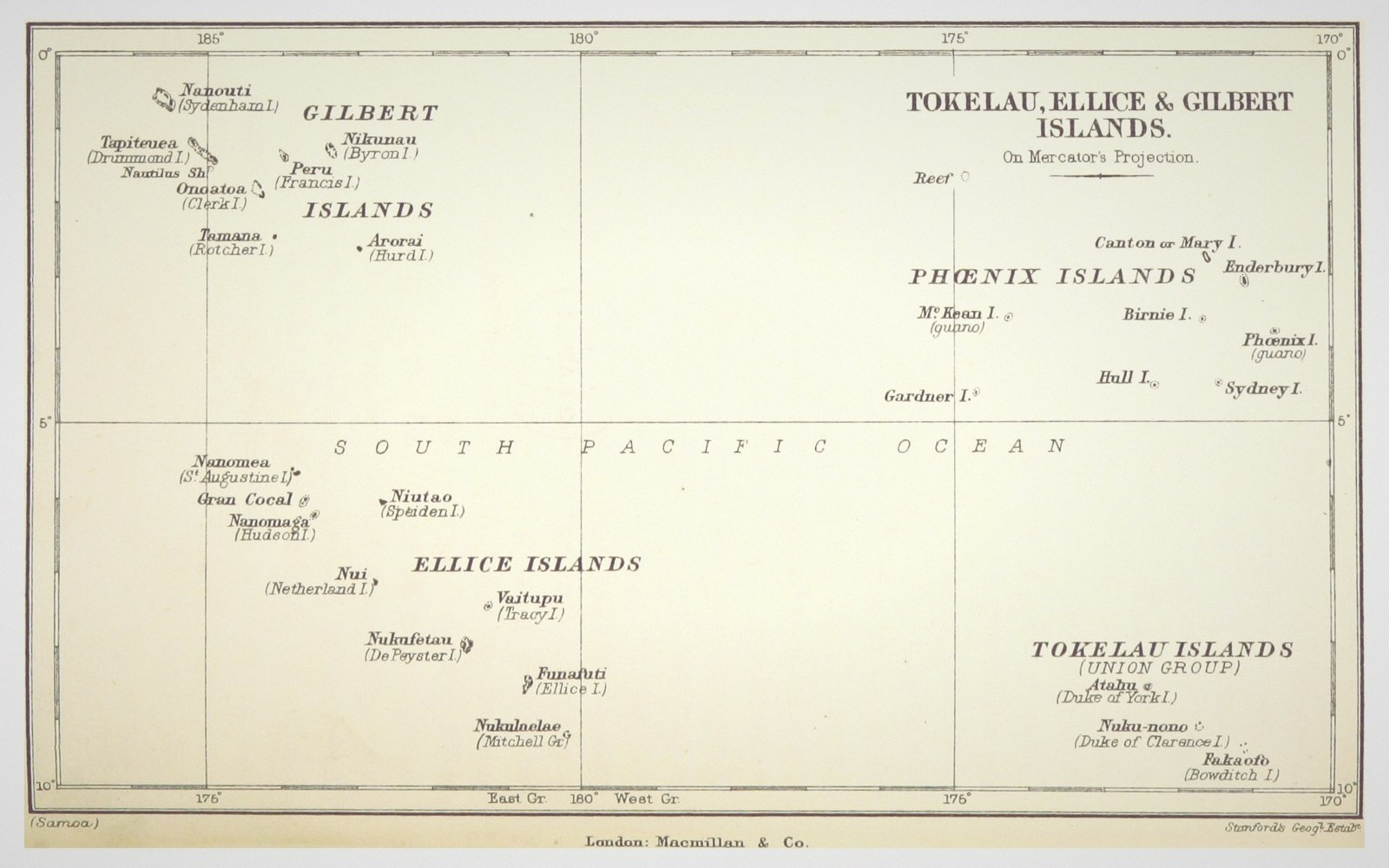 The Gilbert and Ellice Islands ColonyThe colonial administration, how the territory was assembled and governed, and the separation that produced two countries.
 The Relics Are Still on the BeachCoastal guns, bunkers and wrecks in the landscape at Betio and elsewhere — what they are, why they remain, and how a place lives alongside them.