Past the Reef Edge
An atoll's ocean face drops from knee-deep to abyssal in a few hundred metres. Understanding that profile explains almost everything about how these islands exist.
01The Three Zones
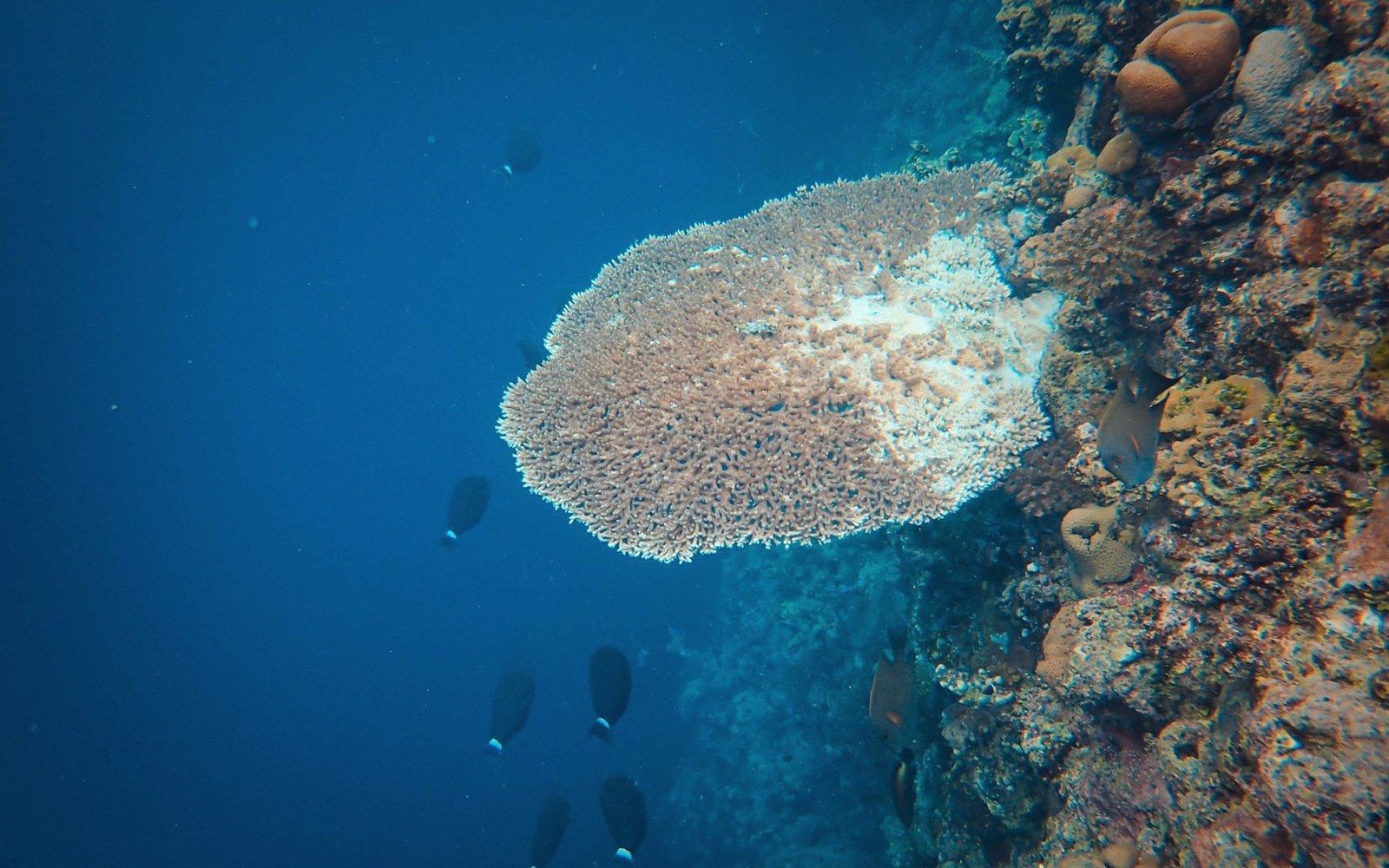
Walk out from shore on the ocean side of a Gilbertese atoll and you cross three distinct worlds in quick succession. The first is the reef flat: a broad, nearly horizontal platform of living and dead coral, typically exposed or awash at low tide, where the water is rarely deeper than a metre. Surge moves across it in sheets. Terns pick over the exposed heads. The footing is uneven and deceptively sharp — coral limestone at various stages of life, death and cementation, with patches of sand and rubble that shift between seasons.
At the outer edge of the flat, the reef crest rises fractionally before it gives way. This crest is the most energetically active zone on the atoll: it is where swell arriving from open ocean breaks and dissipates, giving up the kinetic energy it has carried across thousands of kilometres of unobstructed water. The crest is built from the toughest coral morphologies — encrusting, branching species flattened by the perpetual hammering — and it is what stands between the island and the full force of the Pacific. Without it, the islets behind it do not exist.
Past the crest comes the fore-reef slope, and here the geometry changes completely. The seafloor plunges. In the first hundred metres of horizontal distance it may drop fifty metres or more; within a few hundred metres of the island's outer edge, the water is already measured in hundreds of metres. There is no continental shelf here, no gradual shallow — the atoll sits on the peak of a drowned volcanic seamount, and the ocean floor falls away on all sides toward depths of four kilometres and beyond. Most of Kiribati, measured as volume of water rather than land, is nearly vertical.
02What the Profile Does
This abrupt transition is not just dramatic topography. It governs almost every physical process the atolls experience. The fore-reef slope channels nutrients upward when deeper, colder water is deflected against it — a mechanism that feeds reef life even in the nutrient-poor central Pacific. The swell that builds across the open North or South Pacific arrives at the reef crest with minimal frictional loss; the crest absorbs it in metres rather than kilometres, which is why coral rubble can be thrown well inland during significant storm events. And that same crest is the primary source of the carbonate sediment — broken coral, shell fragments, foram tests — that forms and maintains the islets themselves.
The reef flat on the lagoon side has a different character: calmer, warmer, less oxygenated, with softer corals and a different community of fish. The lagoon and the open ocean, separated by a thin strip of limestone and vegetation, are chemically and biologically distinct environments sharing nothing but proximity.
Sea-level rise works directly on this profile. The critical relationship is between mean sea level and the height of the reef crest: when the ocean surface rises relative to the crest, wave energy that previously broke and dissipated begins to pass over, carrying water, sediment and force onto the flat and toward the island behind it. The mathematics of this are not linear — small vertical changes translate into disproportionate increases in wave overtopping. The reef edge is not a wall. It is a precisely calibrated threshold, shaped over thousands of years, and the margin built into that calibration is measured in centimetres.
 Next in Reef & OceanThe Phoenix Islands Protected AreaOne of the largest marine protected areas on earth: what it covers, what it protects, and the trade-off a small economy accepted to create it.Read it →
 The Lagoon Is a SystemCirculation, flushing, sediment and the biology a lagoon supports — and how causeways and settlement change all of it.
 Tuna and the Licence EconomyKiribati's exclusive economic zone is vast and its fishing licence revenue is central to the national budget. How that works, who fishes there, and what the dependency means.
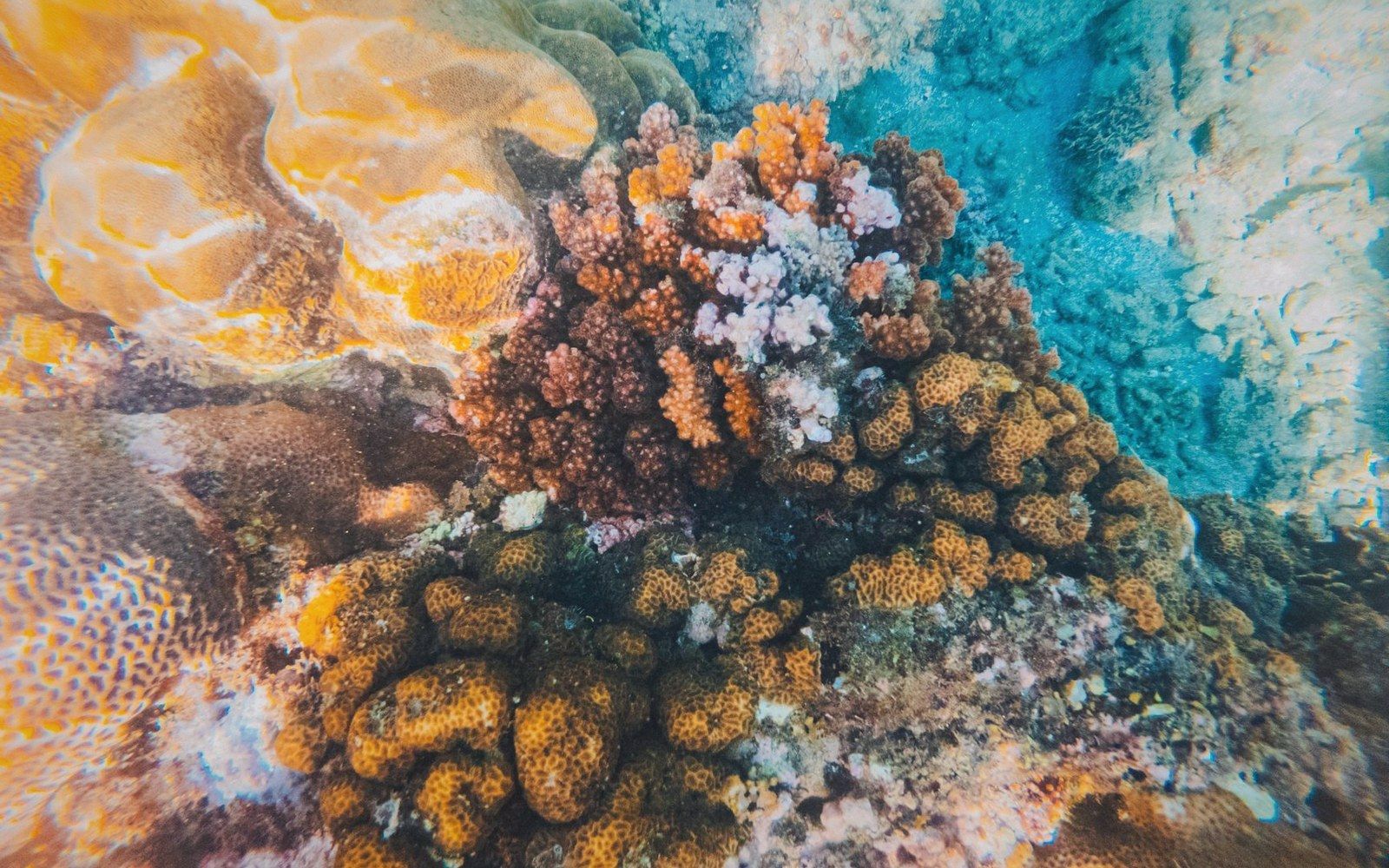 What Bleaching Actually DoesThe mechanism of coral bleaching, the difference between bleached and dead, and the consequences for an island whose land is built of reef material.